

POLICY ON CITIZENS’ IDENTIFICATION, VERIFICATION OF INDIGENE STATUS, AND ISSUANCE OF CERTIFICATES AND OTHER DOCUMENTS OF ORIGIN
Issuing Authority: Isuikwuato Local Government Area, Abia State, Nigeria
Responsible Office: Office of the Head of Service or other designated office
PART I: PRELIMINARY PROVISIONS
1. Title
This Policy shall be known as the Isuikwuato Local Government Area Policy on Citizens’ Identification, Verification of Indigene Status, and Issuance of Certificates and Other Documents of Origin.
2. Background
The issuance of certificates and other official documents confirming a person’s origin is a critical administrative responsibility of the Isuikwuato Local Government Area. Such documents are frequently required for educational admissions, employment, public service applications, scholarships, professional registration, and travel documentation. This Policy establishes a transparent, reliable, and standardised framework for identifying applicants, verifying claims of indigene status, processing applications, and securely issuing official documents. It is designed to protect the integrity of these documents, prevent fraud and misrepresentation, and ensure equitable service for all eligible applicants.
3. Purpose
The purpose of this Policy is to institute a standard administrative framework for identifying and verifying indigenes of the Isuikwuato Local Government Area and to strictly regulate the application, approval, issuance, authentication, replacement, and management of Certificates of Origin.
4. Objectives
The core objectives of this Policy are to:
Establish uniform eligibility and verification requirements for all applicants.
Provide a transparent and highly efficient process for obtaining certificates of origin.
Clearly define the roles of the Local Government, traditional rulers, community leaders, Ward Councillors, and other authorised verification personnel.
Prevent fraudulent claims, impersonation, forgery, unauthorised issuance, and duplication of official documents.
Establish a secure system for storing, retrieving, and authenticating issued documents.
Protect applicants’ personal data and ensure fair administrative treatment.
Provide clear procedures for correcting errors, replacing lost certificates, and resolving disputes.
Strengthen institutional and public confidence in documents issued by the Isuikwuato Local Government Area.
5. Scope of Application
This Policy shall strictly apply to:
All persons applying for certificates or documents confirming their indigene status or origin from the Isuikwuato Local Government Area.
All departments, units, and personnel explicitly authorised to receive, process, verify, approve, issue, or authenticate such documents.
Recognised traditional rulers, Presidents-General, Home Branch Chairmen, Ward Councillors, and other community representatives participating in the official verification process.
Institutions and individuals legally requesting official confirmation of the authenticity of documents issued under this framework.
6. Definitions
For the purposes of this Policy:
“Local Government” means the Isuikwuato Local Government Area, Abia State.
“Indigene” means a person whose claim to origin from Isuikwuato is established through the applicable community, family, ancestral, and administrative verification procedures recognised under this Policy.
“Applicant” means a person applying for a certificate covered by this Policy, or a lawful representative acting on that person’s behalf.
“Certificate of Origin” means an official document issued by the Local Government confirming an individual’s verified claim of origin from Isuikwuato LGA.
“Verification Authority” means a recognised traditional, community, or elected representative officially authorised to provide relevant information for verifying an applicant’s claim.
“Issuing Authority” means the Local Government officer or office formally authorised to approve and issue documents under this Policy.
“Register” means the official physical or electronic record of all applications, verification outcomes, approvals, and issued documents.
“Other Documents of Origin” means any additional official document approved by the Local Government for the confirmation or authentication of an individual’s origin.
PART II: ELIGIBILITY AND APPLICATION
7. Eligibility for a Certificate of Origin
An applicant qualifies for a Certificate of Origin where their claim of indigene status is satisfactorily established under the prescribed verification procedures. Verification shall take account of relevant evidence, including:
The applicant’s claimed autonomous community, town or village, and kindred of origin.
Family and ancestral connections to the claimed community.
Formal confirmation from recognised traditional or community authorities.
Existing credible records or previously issued official documents.
Note: Mere residence, place of birth, marriage, employment, or property ownership within Isuikwuato shall not, by itself, automatically establish indigene status. Furthermore, no application shall be approved or rejected based on political affiliation, religion, gender, disability, social status, or personal relationships with public officials.*
8. Application Requirements
An application for a Certificate of Origin shall ordinarily include:
1. The applicant’s full name and relevant personal particulars (date of birth, gender, marital status).
2. Current contact address, email address, and telephone number.
3. Claimed autonomous community, town or village, and kindred of origin.
4. Names and relevant details of the applicant’s parents.
5. A recent passport photograph with a white background.
6. Acceptable identification and supporting documents from the traditional institution or an acceptable referee.
7. Details regarding the purpose for which the certificate is required.
8. Evidence of payment of the officially approved administrative fee.
The Local Government reserves the right to request additional supporting documents where reasonably necessary. Submission of an application does not constitute proof of indigene status or guarantee issuance.
9. Application Channels
Applications must be submitted through the approved electronic application portal or an officially authorised application centre. Every application shall be assigned a unique reference number for tracking and record-keeping. Applicants are legally bound to provide accurate information; fraudulent submissions are strictly prohibited.
10. Application Acknowledgement and Preliminary Review
Upon receipt, the responsible unit shall:
Acknowledge receipt and issue a reference number.
Verify the completeness of the application form and supporting documents.
Identify the appropriate community verification authorities.
Notify the applicant of any missing information. Incomplete applications may be returned for correction but shall not be outrightly rejected without reasonable notice.
PART III: VERIFICATION OF INDIGENE STATUS
11. General Verification Principle
Every application shall undergo verification proportionate to the claim. Verification must be conducted fairly, consistently, and entirely independently of personal, political, or financial influence.
12. Community-Level Verification
The Local Government shall seek verification from recognised authorities, which may include:
The recognised traditional ruler (Eze) of the relevant autonomous community.
The President-General of the relevant town union or community association.
The Chairman of the relevant Home Branch.
The Ward Councillor representing the relevant ward.
The Local Government shall maintain an official, updated directory of these recognised verification authorities.
13. Verification Procedure
The process shall follow these sequenced steps:
1. Referral: The designated unit forwards application details to the appropriate verification authority.
2. Assessment: The authority reviews the claim against credible community, family, and ancestral records.
3. Confirmation: The authority submits a signed confirmation, rejection, or request for further information.
4. Review: The designated unit assesses the confirmation alongside the applicant’s submitted evidence.
5. Decision: The authorised officer determines eligibility and records the rationale for approval or refusal.
14. Vacant Traditional Stools and Unavailable Authorities
Where the office of an Eze is vacant or the authority is indisposed, verification may be obtained from an officially recognised alternative, such as a Traditional Prime Minister or an acting traditional authority. Conflicts of interest must be declared, and alternative verifiers assigned as necessary.
15. Conflicting or Insufficient Evidence
Applications with conflicting or insufficient evidence will be referred for further review. Applicants may be required to provide supplementary documentary evidence or attend a verification interview. Failure of a verifier to respond within the prescribed period shall not be the sole basis for denying an applicant a certificate; the Local Government shall utilise alternative approved verification methods.
PART IV: APPROVAL AND ISSUANCE OF DOCUMENTS
16. Designated Issuing Authority
The Local Government shall designate a specific department and specific officers explicitly authorised to process, verify, approve, and sign Certificates of Origin. Unauthorised issuance by any third party or non-designated officer is strictly prohibited.
17. Approval and Issuance Procedure
Certificates shall only be issued after:
The application is fully recorded and the identity assessed.
Community verification (or an approved alternative) is complete.
The authorised officer formally approves the application.
The certificate is generated in the approved format, entered into the official register, and authenticated by the authorised signatory.
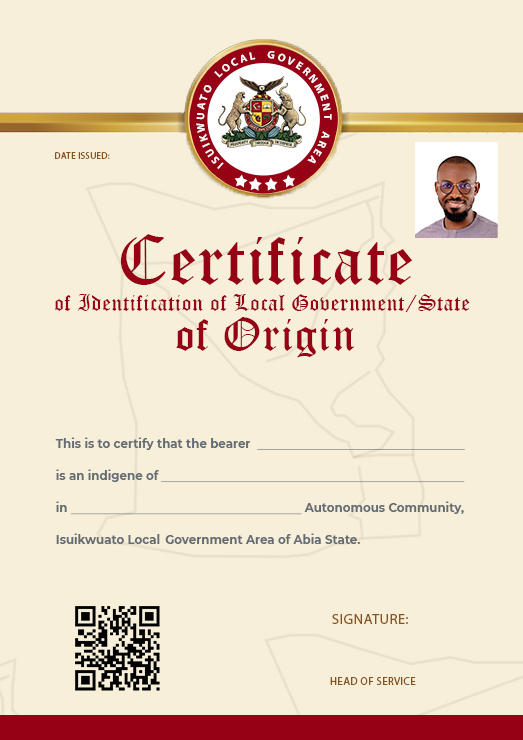
18. Contents of a Certificate of Origin
To ensure authenticity, every Certificate must contain:
The official Isuikwuato Local Government Area name and logo.
A unique certificate identification number.
The applicant’s full name, photograph, and verified community of origin.
The issuance date and the authorised issuing officer’s signature and designation.
Approved security features (e.g., official stamp, QR code, or verification code).
19. Fees and Official Payments
All administrative fees must be formally approved, published, and paid through designated official channels. No officer or verifier shall demand or accept unauthorised facilitation payments, gifts, or personal benefits.
PART V: RECORDS, SECURITY, AND AUTHENTICATION
20. Official Register and Electronic Verification
The Local Government shall maintain a secure central register (electronic, physical, or both) detailing all applications, verification outcomes, and issued documents. An electronic verification system (utilizing QR codes or secure portals) may be deployed to allow external institutions to seamlessly confirm document authenticity without exposing sensitive personal data.
21. Data Protection and Confidentiality
Personal data shall be handled in strict compliance with applicable data protection laws. Access to records shall be restricted to authorised personnel. Information shall not be disclosed to third parties without lawful authorisation or the applicant’s explicit consent.
PART VI: CORRECTIONS, REPLACEMENTS, AND DISPUTES
22. Corrections and Replacements
Applicants may request corrections for administrative errors by providing supporting evidence. For lost or damaged certificates, applicants must provide a formal declaration (e.g., a police report or sworn affidavit). Replacement certificates will be cross-linked to the original record, and the original will be marked as superseded in the verification system to prevent duplicate use.
23. Complaints and Appeals
Applicants dissatisfied with a refusal, delay, or administrative decision may submit a written complaint to a designated review officer. The review process shall be transparent, evidence-based, and bound by published timelines.
PART VII: FRAUD PREVENTION AND ACCOUNTABILITY
24. Prohibited Conduct
The following acts are strictly prohibited and may result in administrative sanctions or criminal prosecution:
Submitting false information, forged documents, or impersonation.
Forging, unlawfully reproducing, or unauthorised issuance of certificates.
Providing false verification confirmations.
Demanding or accepting bribes or unauthorised payments.
Unauthorised alteration or deletion of official records.
25. Sanctions and Revocations
Where fraud or material error is established, the Local Government reserves the right to suspend, cancel, or formally revoke the issued certificate. Affected individuals will be granted a fair opportunity to respond before final adverse actions are taken, consistent with applicable public service rules and laws.
PART VIII & IX: INSTITUTIONAL RESPONSIBILITIES AND IMPLEMENTATION
26. Responsibilities
The Local Government: Approves the framework, designates issuing authorities, maintains the official register, audits the process, and ensures legal compliance.
The Certification Unit: Processes applications, coordinates verification, maintains secure files, and issues approved documents.
Traditional/Community Authorities: Provide truthful, impartial verification within prescribed timelines without exacting unauthorised fees.
27. Public Awareness and Audits
The Local Government shall conduct periodic administrative and records audits to assess compliance, monitor processing times, and address systemic weaknesses. The approved Policy, procedures, and official fees shall be made widely accessible to the public to eliminate reliance on unofficial intermediaries.
To get your certificate, click here.